What Is Aerosol Fire Suppression and Why It Matters
Aerosol fire suppression works through fine particulate agents that interfere directly with combustion chemistry. It suppresses fire by interrupting the reaction chain rather than relying solely on cooling or oxygen displacement. That difference in mechanism determines where the technology fits and how little equipment it needs. It is the principle every Firecom generator is built on.
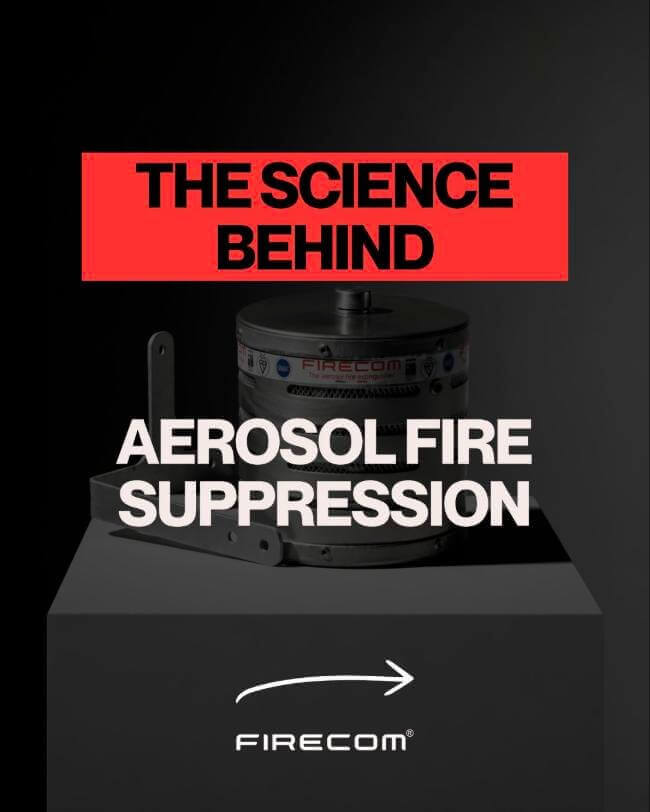
What Is Aerosol Fire Suppression?
1. Microscopic Particles Suspended in Gas
Aerosol fire suppression uses microscopic solid particles suspended in gas to interact directly with the combustion process. Typically one to two micrometres across, they stay suspended and move through a protected space the way a gas does rather than settling like a powder, which is how they distribute rapidly and reach the fire source efficiently.
2. How the Agent Reaches the Flame
When activated, the aerosol generator releases those fine particles, which spread through the environment and interact with flame chemistry. This allows the agent to act directly within the combustion zone rather than only cooling the surroundings, and it removes the need to aim anything at the seat of the fire.
3. Why Chemical Interruption Changes the Outcome
Aerosol technology interrupts the chemical reactions that sustain fire: the potassium-based particles capture the free radicals that propagate the flame, so the chain reaction breaks down from the inside. This makes it particularly effective in enclosed environments with high equipment density and limited access, where flooding the space with water or reducing its oxygen would create a second problem alongside the fire.
Firecom Protection and Aerosol Technology
Because suppression is chemical rather than volumetric, the hardware can be small and self-contained: there is no agent reservoir to size, no pipework to route, and no nozzle to aim.
Their aerosol technology ensures:
- Rapid extinguishing action, with discharge and suppression within seconds of activation
- A non-toxic, eco-friendly agent that does not deplete the oxygen in the protected space
- No water, residue, or pressurised pipework, so protected equipment stays serviceable
This makes Firecom generators straightforward to install inside cabinets, machinery, technical rooms, and vehicles, including existing installations that were never designed around a suppression system.
Conclusion
Aerosol fire suppression is defined by where it acts: inside the flame chemistry itself, rather than on the heat or the air around it. That is what lets a compact device with no pipework protect a volume a conventional system would need cylinders and distribution to cover, and why Firecom aerosol technology suits enclosed, equipment-dense environments.
