5 Myths About Aerosol Fire Suppression
Aerosol fire suppression is often judged on assumptions borrowed from other technologies. Those assumptions shape specifications, budgets and project decisions long before anyone looks at the data. Here are the five misconceptions that come up most often, and what actually happens in the field.
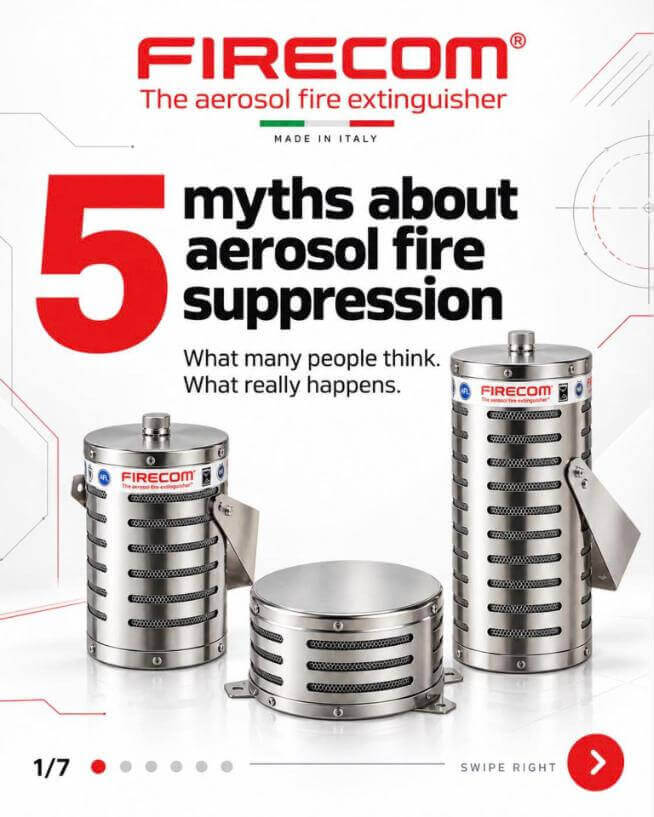
What Do People Get Wrong About Aerosol Fire Suppression?
1. “It’s Like a Pressurized Gas”
It is not. Firecom generators are non-pressurized: there are no cylinders to store, no pressurized lines to route and no dedicated storage room to design around. That single difference changes how and where protection can be installed.
2. “It Leaves Residue and Makes a Mess”
Firecom aerosol is a dry aerosol. It works without water, foam or traditional powders, which makes it suitable even for environments with sensitive electronics where a conventional discharge would cause more damage than the fire.
3. “It Needs a Lot of Space”
The opposite is true. The generators are compact and modular, which makes them ideal for retrofit projects, electrical cabinets, data centres and tight technical spaces that no other fixed system could reach.
4. “It Requires Complex Maintenance”
The system is designed for simplified long-term management. There are no cylinders to recharge and the service life reaches up to 15 years, so the protection stays in place without a recurring maintenance programme built around it.
5. “It’s a Niche Solution”
Aerosol technology is applied across industry, logistics, data centres, transport, electrical cabinets, marine applications and critical infrastructure. The range of installations is far wider than the niche label suggests.
Firecom Protection for Critical Spaces
Taken together, the five corrections point to something bigger than a change of extinguishing agent. Without cylinders, pressure or dedicated rooms, protection can be placed exactly where the risk is instead of where the plant room allows.
Their aerosol technology ensures:
- Protection installed directly inside the protected volume, including existing buildings
- No pressurized storage, no dedicated technical room, no piping network
- A dry discharge that leaves sensitive equipment usable after the event
That is why aerosol systems are chosen for spaces where a traditional installation would be impossible, invasive or simply too slow to retrofit.
Conclusion
Aerosol technology is not a simple alternative to existing systems. It is a different way to design safety, and judging it by the rules of pressurized gas misses exactly what makes it useful.
